These notes were originally written by me (Alex) in the fall of 2011 based on what was then one of the first MOOC [massively open online courses] produced by Dr. Andrew Ng (Stanford)
I took the course and kept (and in many places expanded) detailed notes of the topics and ideas
I then shared these notes online in November 2011, and for a long time (2011-2019), these resources recieved million of unique views per month.
In the summer of 2026, I (Alex) - with some help from my buddy Claude Opus 4.6 - converted these notes from the horrific HTML they were previously first to clean HTML (replacing screenshots of equations with actual equations where possible), and then reverse-engineered the notes into markdown and wrote a simple parser to convert that markdown back to HTML.
I also extended to some more modern AL/ML ideas, with the goal of continuining to expand these notes with material sufficient to provide a solid foundation in modern AI/ML/DL
As of Sept. 2026 I am working through the notes to update/clarify fix things
However, the notes retain their terse, to-the-point style with the goal of being high-yeild easy-to-read material to establish the foundations of machine learning and deep learning.
Course overview
We will learn about
State of the art
How to do the implementation
Historic applications of machine learning include
Search
Photo tagging
Spam filters
More modern applications include
Generative image creation tools
Chatbots
Agentic workflows to orchestrate thins
The (historic) AI dream was to build machines as intelligent as humans
In 2026, the moving target is to do this safely and ethically
What is the best way to build machine learning systems?
One school of thought: mimic how humans learn.
Driven reinforcement learning
Another school of thought: the best models simply use the most data and the most compute - trying to mimic humans is appealing to our own brains, but largely futile.
Driven deep learning
What the course covers
Learn classic, foundational algorithms
But the algorithms and math alone are no good
Need to know how to get these to work in problems
Why is ML so prevalent?
Grew out of AI
Build intelligent machines
You can program a machine how to do some simple thing
For the most part hard-wiring AI is too difficult
Best way to do it is to have some way for machines to learn things themselves
A mechanism for learning - if a machine can learn from input then it does the hard work for you
Examples
Database mining
Machine learning has recently become so big partly because of the huge amount of data being generated
Large datasets from growth of automation web
Sources of data include
Web data (click-stream or click through data)
Mine to understand users better
Huge segment of silicon valley
Medical records
Electronic records -> turn records into knowledge
Biological data
Gene sequences, ML algorithms give a better understanding of human genome
Engineering info
Data from sensors, log reports, photos etc
Applications that we cannot program by hand
Autonomous helicopter
Handwriting recognition
This is very inexpensive because when you write an envelope, algorithms can automatically route envelopes through the post
Natural language processing (NLP)
AI pertaining to language
Computer vision
AI pertaining to vision
Self customizing programs
Netflix [still true in 2026]
Amazon [still true in 2026]
Spotify [added in 2026]
iTunes genius [kept for historical reasons, no longer true in 2026]
Take users info
Learn based on your behavior
Understand human learning and the brain
If we can build systems that mimic (or try to mimic) how the brain works, this may push our own understanding of the associated neurobiology
What is machine learning?
Here we...
Define what it is
When to use it
Not a well defined definition
Couple of examples of how people have tried to define it
Arthur Samuel (1959)
Machine learning:"Field of study that gives computers the ability to learn without being explicitly programmed"
Samuel wrote a checkers playing program
Had the program play 10000 games against itself
Work out which board positions were good and bad depending on wins/losses
Tom Mitchell (1998)
Well posed learning problem:"A computer program is said to learn from experience E with respect to some class of tasks T and performance measure P, if its performance at tasks in T, as measured by P, improves with experience E."
The checkers example:
E = 10000s games
T is playing checkers
P if you win or not
Several types of learning algorithms
Supervised learning
Teach the computer how to do something, then let it use its new found knowledge to do it
Unsupervised learning
Let the computer learn how to do something, and use this to determine structure and patterns in data
Semi-supervised learning
Teach the computer with a few clear examples, then let it explore a mountain of unlabelled data to figure out the rest on its own
Reinforcement learning
Let the computer learn by trial and error, using rewards and penalties to figure out the best actions to achieve a goal
Recommender systems
Teach the computer what people like, then let it predict what a specific person will want next.
This course
Look at practical advice for applying learning algorithms
Learning a set of tools and how to apply them
Supervised learning - introduction
Probably the most common problem type in machine learning
Starting with an example
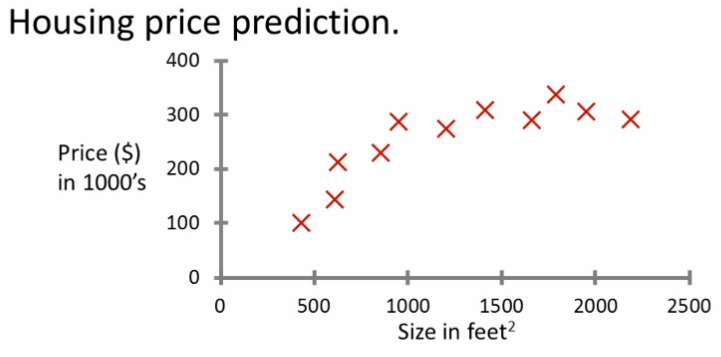
How do we predict housing prices
Collect data regarding housing prices and how they relate to size in feet
Example problem: "Given this data, a friend has a house 750 square feet - how much can they be expected to get?"
What approaches can we use to solve this?
Straight line through data
Maybe $150 000
Second order polynomial
Maybe $200 000
One thing we discuss later - how to choose straight or curved line?
Each of these approaches represent a way of doing supervised learning
What does this mean?
We gave the algorithm a data set where a "right answer" was provided
So we know actual prices for houses
The idea is we can learn what makes the price a certain value from the training data
The algorithm should then produce more right answers based on new training data where we don't know the price already
i.e. predict the price
We also call this a regression problem
Predict continuous valued output (price)
No real discrete delineation
Another example
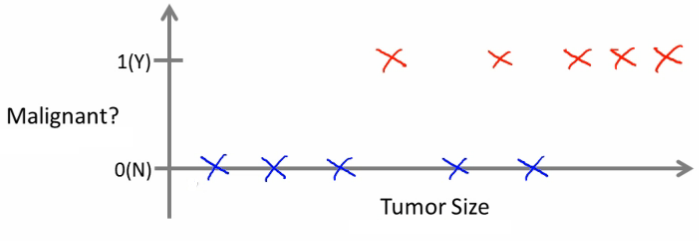
Can we define breast cancer as malignant or benign based on tumour size
Looking at data
Five of each
Can you estimate prognosis based on tumor size?
This is an example of a classification problem
Classify data into one of two discrete classes - no in between, either malignant or not
In classification problems, can have a discrete number of possible values for the output
e.g. maybe have four values
0 - benign
1 - type 1
2 - type 2
3 - type 3
In classification problems we can plot data in a different way
Use only one attribute (size)
In other problems may have multiple attributes
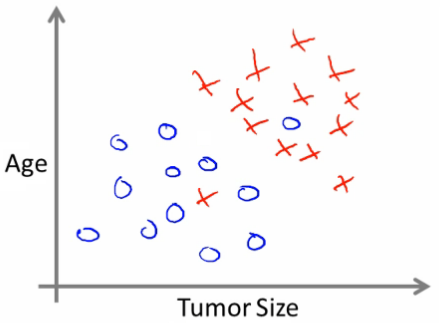
We may also, for example, know age and tumor size
Based on that data, you can try and define separate classes by
Drawing a straight line between the two groups
Using a more complex function to define the two groups (which we'll discuss later)
Then, when you have an individual with a specific tumor size and who is a specific age, you can hopefully use that information to place them into one of your classes
You might have many features to consider
Clump thickness
Uniformity of cell size
Uniformity of cell shape
The most exciting algorithms can deal with an infinite number of features
How do you deal with an infinite number of features?
Neat mathematical trick in support vector machine (which we discuss later)
If you have an infinitely long list - we can develop an algorithm to deal with that
Summary
Supervised learning lets you get the "right" data
Regression problem
Classification problem
Unsupervised learning - introduction
Second major problem type
In unsupervised learning, we get unlabeled data
Just told - here is a data set, can you structure it
One way of doing this would be to cluster data into two groups
This is a clustering algorithm
Clustering algorithm
Example of clustering algorithm
Google news
Groups news stories into cohesive groups
Used in many other problems as well
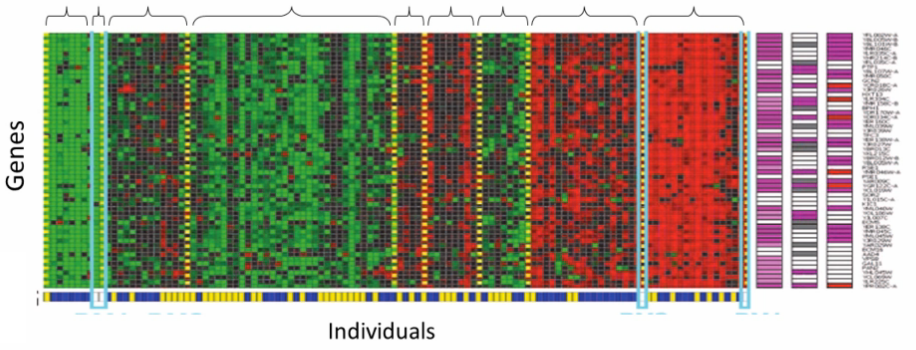
Genomics
Microarray data
Have a group of individuals
On each measure expression of a gene
Run algorithm to cluster individuals into types of people
Organize computer clusters
Identify potential weak spots or distribute workload effectively
Social network analysis
Customer data
Astronomical data analysis
Algorithms give amazing results
Basically
Can you automatically generate structure
Because we don't give it the answer, it's unsupervised learning
Cocktail party algorithm
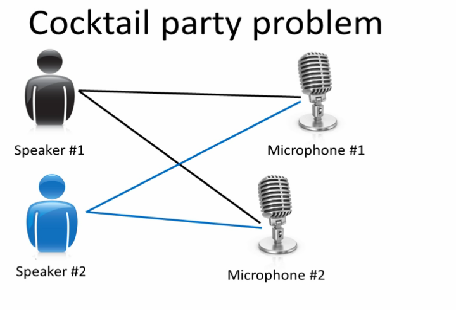
Cocktail party problem
Lots of overlapping voices - hard to hear what everyone is saying
Two people talking
Microphones at different distances from speakers
Record slightly different versions of the conversation depending on where your microphone is
But overlapping none the less
Have recordings of the conversation from each microphone