1) Look at how a complex system can be put together
2) The idea of a machine learning pipeline
What to do next
How to do it
3) Some more interesting ideas
Applying machine learning to tangible problems
Artificial data synthesis
What is the photo OCR problem?
Photo OCR = photo optical character recognition
With growth of digital photography, lots of digital pictures
One idea which has interested many people is getting computers to understand those photos
The photo OCR problem is getting computers to read text in an image
Possible applications for this would include
Make searching easier (e.g. searching for photos based on words in them)
Car navigation
OCR of documents is a comparatively easy problem
From photos it's really hard
OCR pipeline
1) Look through image and find text
2) Do character segmentation
3) Do character classification
4) Optional some may do spell check after this too
We're not focussing on such systems though
The photo OCR pipeline: four stages, each a machine learning system in its own right.
Pipelines are common in machine learning
Separate modules which may each be a machine learning component or data processing component
If you're designing a machine learning system, pipeline design is one of the most important questions
Performance of pipeline and each module often has a big impact on the overall performance of a problem
You would often have different engineers working on each module
Offers a natural way to divide up the workload
Sliding window image analysis
How do the individual models work?
Here focus on a sliding windows classifier
Chapter 26 shows where this idea ends up: a convolutional network is a sliding window with the detector learned and the sliding built into the arithmetic
As mentioned, stage 1 is text detection
Unusual problem in computer vision - different rectangles (which surround text) may have different aspect ratios (aspect ratio being height : width)
Text may be short (few words) or long (many words)
Tall or short font
Text might be straight on
Slanted
Let's start with a simpler example
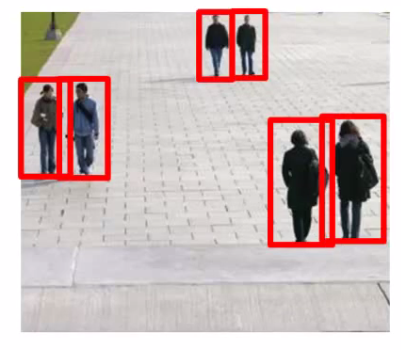
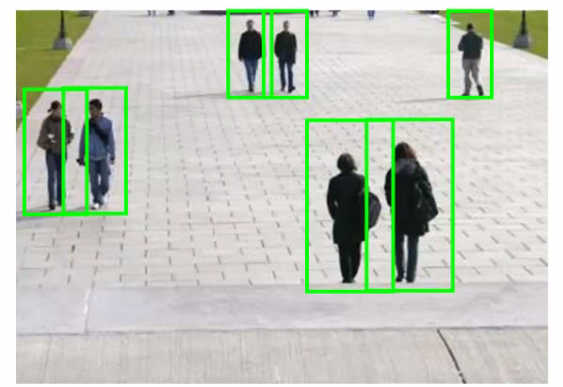
Pedestrian detection
Want to take an image and find pedestrians in the image
This is a slightly simpler problem because the aspect ratio remains pretty constant
Building our detection system
Have 82 x 36 aspect ratio
This is a typical aspect ratio for a standing human
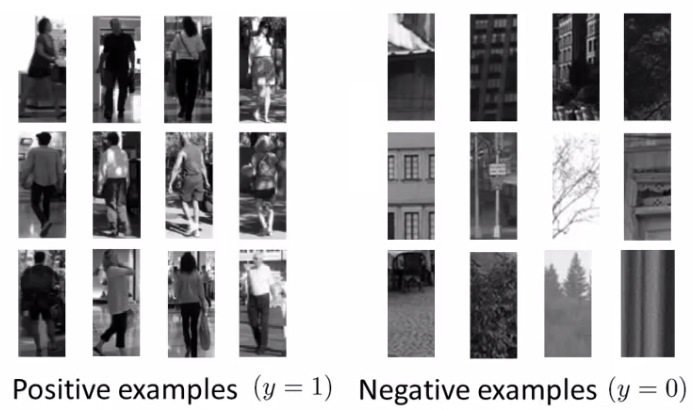
Collect training set of positive and negative examples
Could have 1000 - 10 000 training examples
Train a neural network to take an image and classify that image as pedestrian or not
Gives you a way to train your system
Now we have a new image - how do we find pedestrians in it?
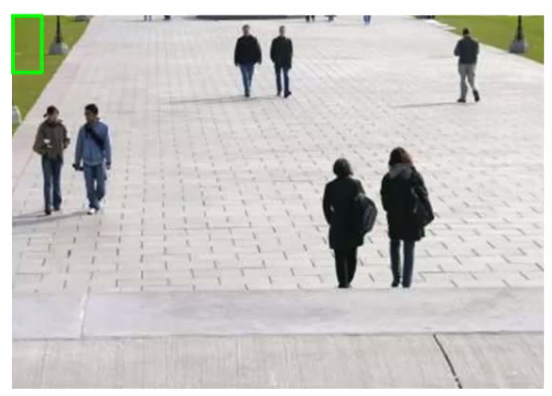
Start by taking a rectangular 82 x 36 patch in the image
Run patch through classifier - hopefully in this example it will return y = 0
Next slide the rectangle over to the right a little bit and re-run
Then slide again
The amount you slide each rectangle over is a parameter called the step-size or stride
Could use 1 pixel
Best, but computationally expensive
More commonly 5-8 pixels used
So, keep stepping rectangle along all the way to the right
Eventually get to the end
Then move back to the left hand side but step down a bit too
Repeat until you've covered the whole image
Now, we initially started with quite a small rectangle
So now we can take a larger image patch (of the same aspect ratio)
Each time we process the image patch, we're resizing the larger patch to a smaller image, then running that smaller image through the classifier
Hopefully, by changing the patch size and rastering repeatedly across the image, you eventually recognize all the pedestrians in the picture
Text detection example
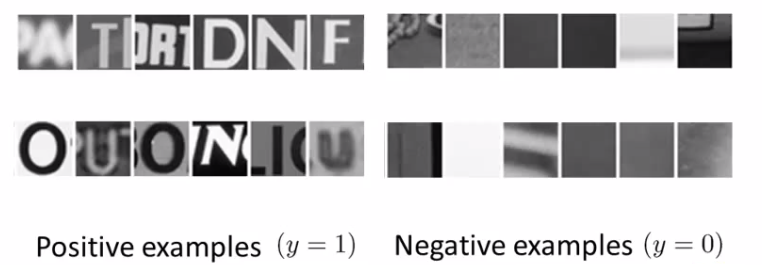
Like pedestrian detection, we generate a labeled training set with
Positive examples (some kind of text)
Negative examples (not text)
Having trained the classifier we apply it to an image
So, run a sliding window classifier at a fixed rectangle size
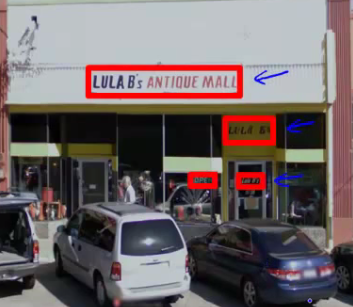
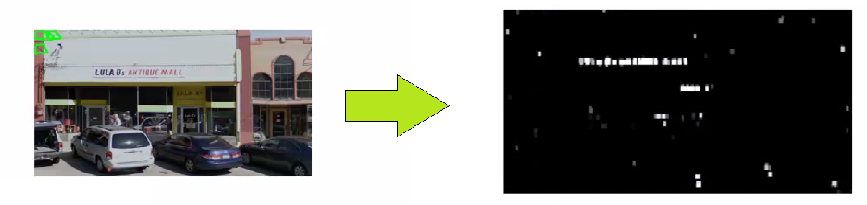
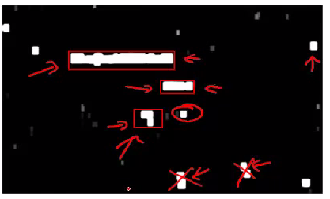
If you do that end up with something like this
White region show where text detection system thinks text is
Different shades of gray correspond to probability associated with how sure the classifier is the section contains text
Black - no text
White - text
For text detection, we want to draw rectangles around all the regions where there is text in the image
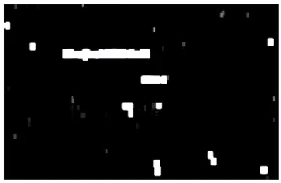
Take classifier output and apply an expansion algorithm
Takes each of white regions and expands it
How do we implement this
Say, for every pixel, is it within some distance of a white pixel?
If yes then colour it white
Look at connected white regions in the image above
Draw rectangles around those which make sense as text (i.e. tall thin boxes don't make sense)
This example misses a piece of text on the door because the aspect ratio is wrong
Very hard to read
Stage two is character segmentation
Use supervised learning algorithm
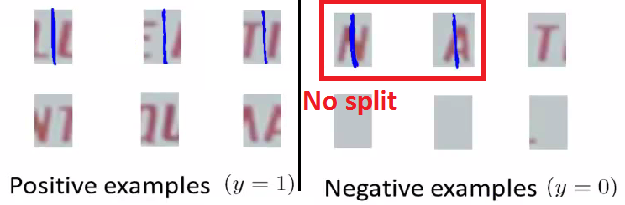
Look in a defined image patch and decide, is there a split between two characters?
So, for example, our first training data item below looks like there is such a split
Similarly, the negative examples are either empty or hold a full character
We train a classifier to try and classify between positive and negative examples
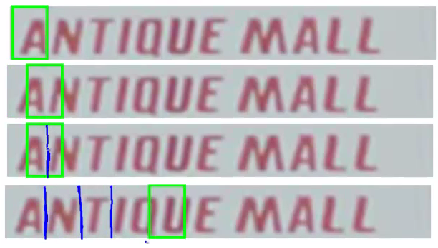
Run that classifier on the regions detected as containing text in the previous section
Use a 1-dimensional sliding window to move along text regions
Does each window snapshot look like the split between two characters?
If yes insert a split
If not move on
So we have something that looks like this
Character classification
Standard OCR, where you apply standard supervised learning which takes an input and identifies which character we decide it is
Multi-class classification problem
Getting lots of data: Artificial data synthesis
We've seen over and over that one of the most reliable ways to get a high performance machine learning system is to take a low bias algorithm and train on a massive data set
Where do we get so much data from
In ML artificial data synthesis
Doesn't apply to every problem
If it applies to your problem can be a great way to generate loads of data
Two main principles
1) Creating data from scratch
2) If we already have a small labeled training set can we amplify it into a larger training set
Character recognition as an example of data synthesis
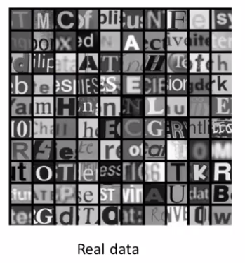
If we go and collect a large labeled data set will look like this
Goal is to take an image patch and have the system recognize the character
Treat the images as gray-scale (makes it a bit easier)
How can we amplify this
Modern computers often have a big font library
If you go to websites, huge free font libraries
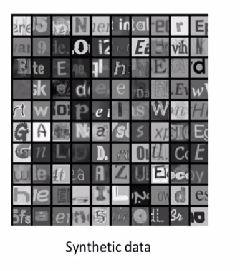
For more training data, take characters from different fonts, paste these characters against random backgrounds
After some work, can build a synthetic training set
Random background
Maybe some blurring/distortion filters
Takes thought and work to make it look realistic
If you do a sloppy job this won't help!
So unlimited supply of training examples
This is an example of creating new data from scratch
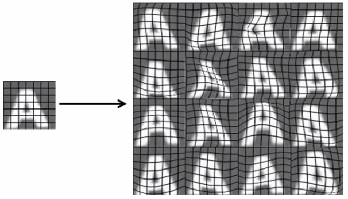
Other way is to introduce distortion into existing data
e.g. take a character and warp it
16 new examples
Allows you to amplify existing training set
This, again, takes thought and insight in terms of deciding how to amplify
Another example: speech recognition
Learn from audio clip - what were the words
Have a labeled training example
Introduce audio distortions into the examples
So only took one example
Created lots of new ones!
When introducing distortion, they should be reasonable relative to the issues your classifier may encounter
Getting more data
Before creating new data, make sure you have a low bias classifier
Plot learning curve
If not a low bias classifier increase number of features
Then create large artificial training set
Very important question: How much work would it be to get 10x data as we currently have?
Often the answer is, "Not that hard"
This is often a huge way to improve an algorithm
Good question to ask yourself or ask the team
How many minutes/hours does it take to get a certain number of examples
Say we have 1000 examples
10 seconds to label an example
So we need another 9000 examples = 90 000 seconds
Comes to a few days (25 hours!)
Crowd sourcing is also a good way to get data
Risk or reliability issues
Cost
Example
E.g. Amazon mechanical turks
Ceiling analysis: What part of the pipeline to work on next
Through the course repeatedly said one of the most valuable resources is developer time
Pick the right thing for you and your team to work on
Avoid spending a lot of time to realize the work was pointless in terms of enhancing performance
Photo OCR pipeline
Three modules
Each one could have a small team on it
Where should you allocate resources?
Good to have a single real number as an evaluation metric
So, character accuracy for this example
Find that our test set has 72% accuracy
Ceiling analysis on our pipeline
We go to the first module
Mess around with the test set - manually tell the algorithm where the text is
Simulate if your text detection system was 100% accurate
So we're feeding the character segmentation module with 100% accurate data now
How does this change the accuracy of the overall system
Ceiling analysis: hand-label the text detection stage so it is perfect, run the rest of the pipeline, and see how much the end-to-end accuracy improves. That number is the most this stage could ever be worth.
Accuracy goes up to 89%
Next do the same for the character segmentation
Accuracy goes up to 90% now
Finally do the same for character recognition
Goes up to 100%
Having done this we can quantitatively show what the upside to improving each module would be
Perfect text detection improves accuracy by 17%!
Would bring the biggest gain if we could improve
Perfect character segmentation would improve it by 1%
Not worth working on
Perfect character recognition would improve it by 10%
Might be worth working on, depends if it looks easy or not
The "ceiling" is that each module has a ceiling by which making it perfect would improve the system overall
Other example - face recognition
NB this is not how it's done in practice
A face recognition pipeline, used to show that ceiling analysis applies to any pipeline, not just OCR.
Probably more complicated than is used in practice
How would you do ceiling analysis for this
Overall system is 85%
Perfect background -> 85.1%
Not a crucial step
+ Perfect face detection -> 91%
Most important module to focus on
+ Perfect eyes ->95%
+ Perfect Nose -> 96%
+ Perfect Mouth -> 97%
+ Perfect logistic regression -> 100%
Cautionary tale
Two engineers spent 18 months improving background pre-processing
Turns out had no impact on overall performance
Could have saved three years of man power if they'd done ceiling analysis